
How to Search Lafayette County Civil Dockets
For Lafayette County Circuit and County Court civil matters, the first stop is the official Delta Circuit/County Court Case Search. The query options are broad. You can search by Party Name or case number. Styled plaintiff or defendant works too, as do filed date, final disposition date, docket book/page, and file number. One caution, though. The page notes that Circuit and County updates ended February 26, 2024. Lafayette Circuit and County Court went live in MEC on that same date, so a Delta result may lag behind the newest entry.
A PAMEC/MEC account opens the electronic route for participating courts and non-restricted material. Chancery Court documents moved to MEC in 2023. The Chancery Clerk states that Delta now serves land records only. A Justice Court civil case runs through its own channel. When the portal returns no match, the clerk can still help. Bring the court, the case number or full party name, and the approximate year. Add the document needed and the copy type.
- Identify the court from the summons, order, notice, or case number before beginning a Lafayette County civil docket search.
- Use an exact case number when available; otherwise search one party-name field and then narrow by date or styled party.
- Compare the court, case type, filing date, and last entry before opening or requesting a document.
- Use PAMEC/MEC for newer participating court records and the Chancery MEC path for Chancery documents.
- Ask the correct clerk for a current setting, a plain copy, or a certified copy when online access is incomplete.
Lafayette County Civil Docket Court Limits
Which court took the case is itself a civil docket fact. Circuit Court serves as the general civil trial court. County Court holds concurrent civil jurisdiction up to $200,000 plus exclusive and appellate categories. Justice Court handles civil cases under $3,500. Chancery Court covers equity, domestic relations, probate, guardianship, land, and related matters. So one party name can surface in very different Lafayette County civil dockets.
| Court | Civil docket focus | Record route |
|---|---|---|
| Circuit Court | General civil lawsuits and certain appeals | Circuit Clerk, Delta history, and MEC |
| County Court | Concurrent civil cases up to $200,000 and local appeals | Circuit Clerk and MEC |
| Chancery Court | Equity, family, probate, guardianship, and land matters | Chancery Clerk and Chancery MEC |
| Justice Court | Civil cases under $3,500 | Justice Court clerk |
The Lafayette County Chancery Clerk’s record-access page is the source for this civil-docket image.
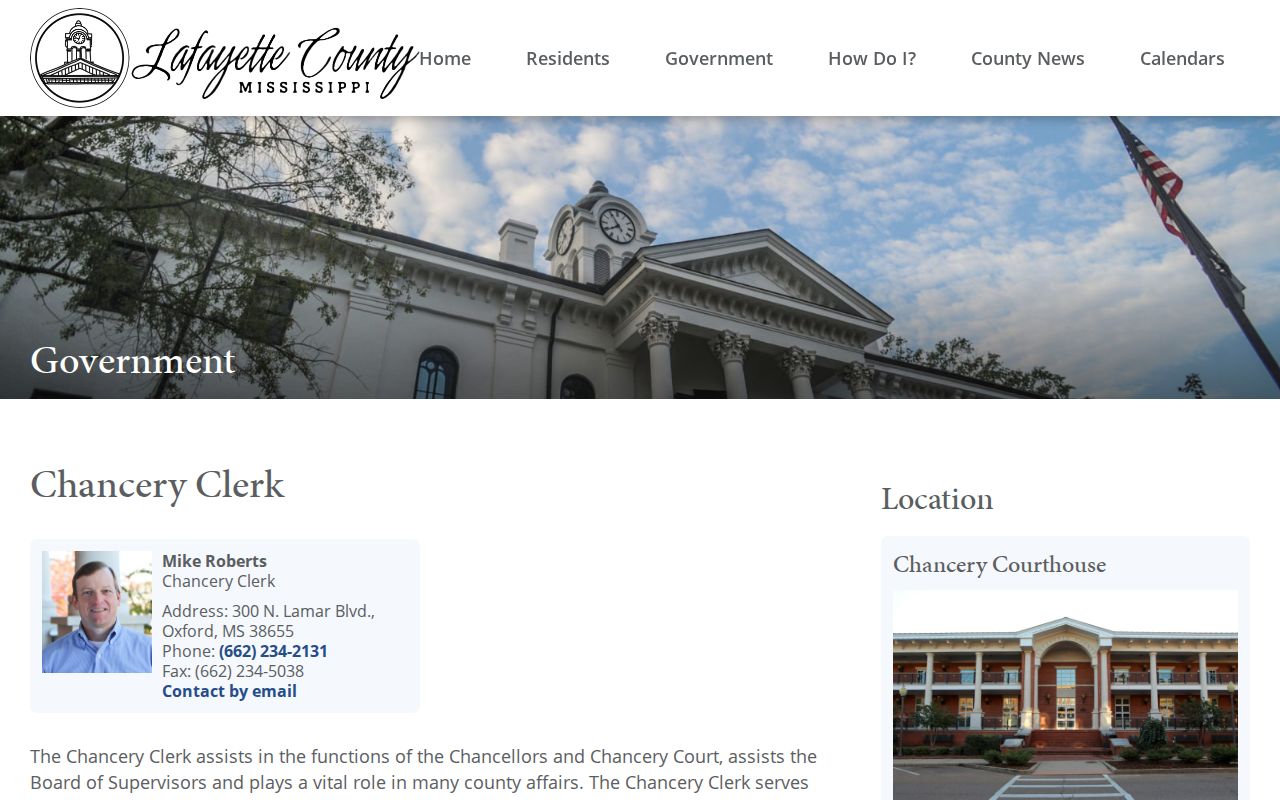
The clerk split is practical. The Lafayette County Circuit Clerk is the starting point for Circuit and County Court records. The Lafayette County Chancery Clerk, meanwhile, keeps the Chancery court record along with the related public land-record stream.
What a Civil Docket Shows
Think of a civil docket as an index of activity, not the full case file. Lafayette County posts no live docket sheet. The reliable field inventory comes from the official Delta controls, the AOC/01 Civil Case Filing Form, and MEC terminology. A party can expect case identification and an origin category. Parties and attorneys appear, along with a running sequence of filings and settings, motion activity, and a final or interim order. How much of a document you can see depends on the court. The record's age and any access restriction matter too.
| Court identification | The filing form uses county number, judicial district, docket number, case year, chronological number, local docket ID, and older-case number fields. |
|---|---|
| Origin of suit | Initial filing, reinstated, foreign judgment enrolled, transfer, remand, reopened case, appeal, or another listed origin. |
| Parties and attorneys | Plaintiff and defendant information, estate or entity capacity, attorney information, and filer status where filed. |
| Case events | Service, answer, motion, discovery, mediation, setting, continuance, trial, judgment, appeal, satisfaction, or closure. |
| Record result | An order, judgment, dismissal, satisfaction, or administrative status should be read in context with the underlying entry. |
Lafayette County Civil Docket Filing Categories
The Lafayette AOC/01 Civil Case Filing Form shows why a broad civil name search can pull together unlike matters. Its nature-of-suit fields span property and business disputes. Commercial matters, domestic relations, probate, torts, contracts, appeals, guardianship, and estates appear too, along with civil forfeiture and administrative agency matters. That list does not guarantee each category appears as a public portal filter. Delta's Case Type options are not published, so treat no local dropdown values as settled.
- Reinstated
- A prior matter returns to active court handling under an origin category on the filing form.
- Remanded
- A case has been sent back to a lower court or prior forum after a higher-court action.
- Foreign judgment enrolled
- A judgment from another jurisdiction is presented for recognition or enforcement procedures.
- Satisfaction
- A judgment or obligation is recorded as paid or fulfilled.
Classification helps a clerk and court route a case correctly at filing. It still does not replace reading the docket entry or the order that controls a specific civil matter.
Types of Civil Cases on the Docket
Lafayette County civil dockets mirror the jurisdiction of whichever court received the filing. Circuit and County Court records can hold general civil litigation and appeals. Chancery civil records may involve domestic relations, probate, guardianship, equity, and land and title disputes. Justice Court covers smaller civil matters within its jurisdiction. The filing form's long list of categories is a useful reminder. Confirm both the court and the case type before treating similarly named results as related.
- Contract, debt-collection, business, and other general civil claims
- Tort, negligence, malpractice, premises, product-liability, and wrongful-death matters
- Real-property, title, boundary, easement, lien, partition, foreclosure, and tax-sale proceedings
- Domestic-relations, custody, visitation, support, divorce, and property-division matters where publicly accessible
- Probate, estate, guardianship, conservatorship, appeal, and administrative-agency matters
Lafayette County Civil Docket Chancery Route
Chancery Court is its own Lafayette County civil docket route. Its official materials connect an 8.05 Financial Statement, an Order of Setting, and an Order Continuing Case and Resetting. A motion and order concerning fault grounds appears there too, along with Chancery Court fees and Mississippi Rule of Civil Procedure 5.1. Those forms signal the record types and procedures that can shape a Chancery search. They also explain a common blind spot. A search limited to the Circuit and County interface can miss court records. Family, probate, guardianship, or land-related entries may go unseen.
The Lafayette County Chancery Court jurisdiction page is the source for this civil-docket image.
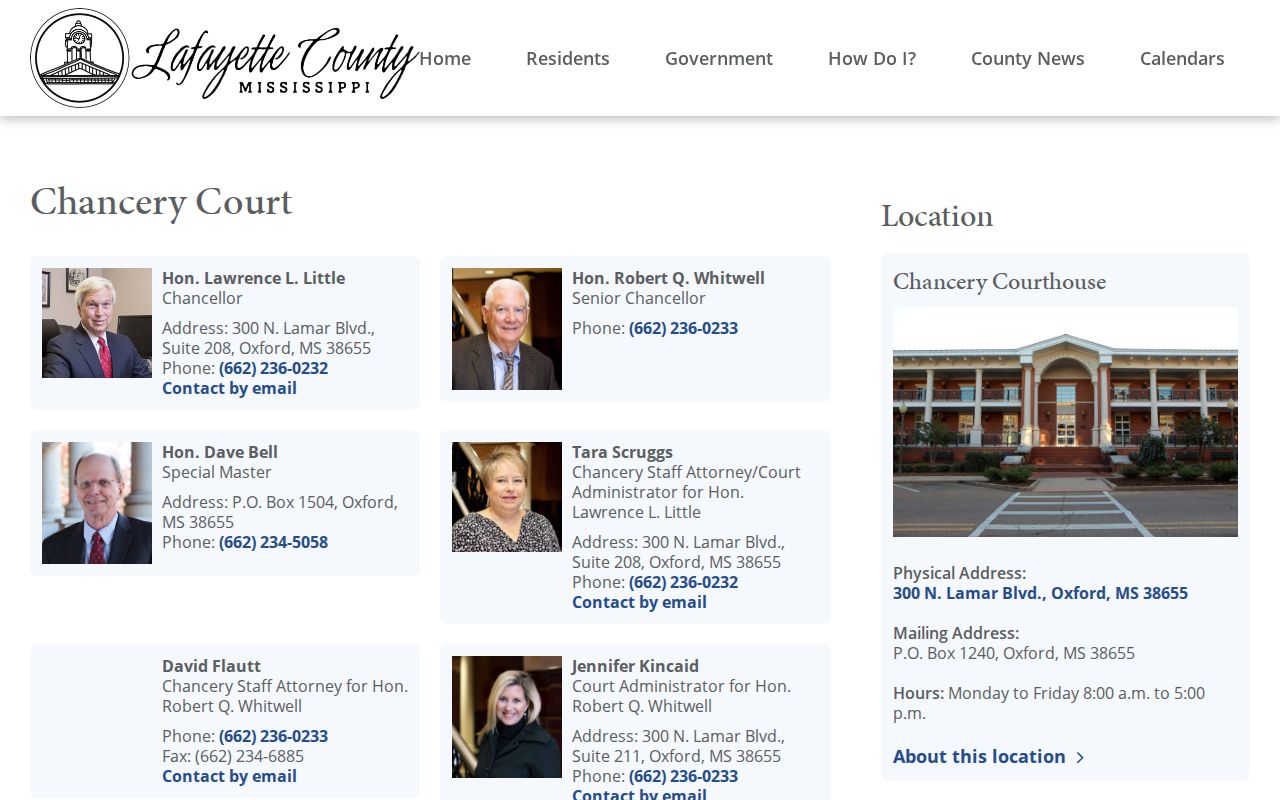
Chancery Court's public land records are related but distinct from its court documents. Per the Chancery Clerk, Delta remains the land-record route, while court documents now live in MEC.
Settings and Hearings on Civil Dockets
A setting on a Lafayette County civil docket is a scheduled court event. It is not automatically a trial. The entry might point to a hearing or a motion, and it could also be mediation, a pretrial conference, early neutral evaluation, trial, or another case-management step. In Chancery matters, watch for a signed order of setting or an order continuing and resetting the case. Those papers carry real weight. Read the date, the time, the court or division, the event type, and any appearance requirement as one package.
A continuance moves a setting. A bare request changes nothing. The court date stands until the clerk or a controlling court notice says otherwise. To sort out the local difference between terms, law days, municipal schedules, and settings, see the Lafayette County court calendar reference.
Lafayette County Civil Docket MEC Access
MEC is Mississippi's electronic filing and docket system. PAMEC is how the public registers. The Chancery MEC query page may greet you with a login, a permission notice, or a restriction message. Registering does not unlock everything. Access can hinge on the court, the record type, and your role, especially where privacy rules, sealing, child-related material, or other confidentiality provisions apply. The Thirteenth Chancery MEC query and login page is the official page. It anchors this civil-docket image.
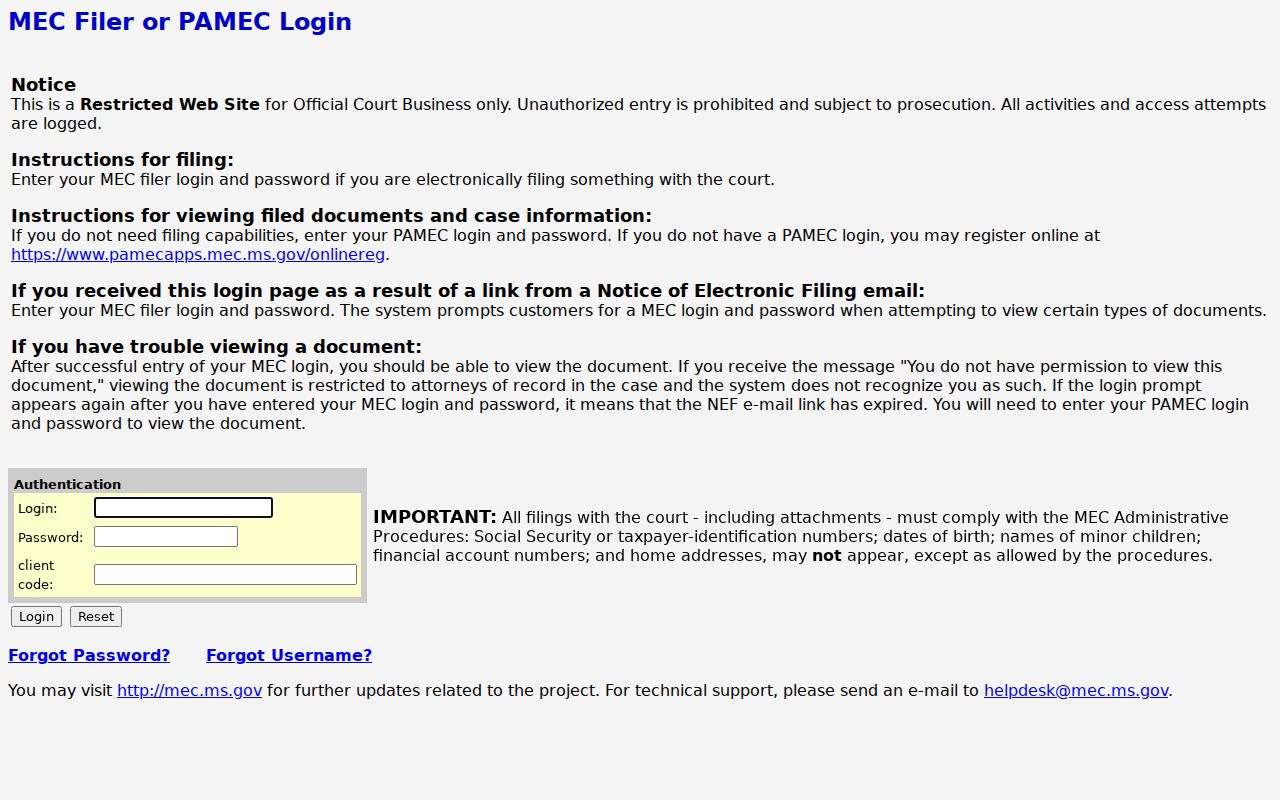
The screen shows the separate electronic path for Chancery records. If a restriction notice appears, do not try to bypass it. Ask the Chancery Clerk instead whether a lawfully available docket entry or order can be requested.
Public Access to Civil Dockets
The Mississippi Public Records Act of 1983 opens the door to non-exempt public records. Court files still answer to stricter rules. Privacy rules, confidentiality statutes, and court orders all apply. Mississippi Rule of Civil Procedure 5.1 makes electronic courts and clerks with online access follow MEC privacy procedures. Some details get special handling. Social Security numbers, tax identifiers, birth dates, minor names, financial-account numbers, and home addresses are the flagged categories requiring redaction or extra care.
Public does not mean unrestricted. Mississippi’s Public Records Act guidance explains the inspection and copying framework, redaction of exempt material where possible, and written-denial requirements.
A sealed result, no-permission message, or missing index entry should be checked with the clerk. Do not reproduce protected information from a filing or older search result.
Lafayette County Civil Docket Fees
The current Lafayette Circuit/County fee schedule took effect January 1, 2026. A civil filing costs $161. Plain copies run $1 per page, and certified copies cost $2.50 per copy. Civil or criminal research is $10, payable by cash or money order only. Particular filings carry separate amounts. Appeals, reinstatements, foreign judgments, transfers, garnishments, satisfactions, judgment renewals, and sheriff service are examples. Whatever description attaches to your requested filing controls.
| Request or filing item | Listed amount |
|---|---|
| Circuit/County civil filing | $161 |
| Plain copy | $1 per page |
| Certified copy | $2.50 per copy |
| Civil/criminal research | $10, cash or money order only |
The county's Chancery Building information is the official source for this Lafayette County civil docket image.

Before you send money or show up for a record, confirm three things: the current fee, which clerk holds the file, and whether you want a court document or a distinct land-record search. Chancery land records sit with a different office and follow a different access path than Chancery court documents, even when the same parties appear in both. Note: A fee schedule supports a request estimate, but the clerk should confirm the amount and payment method for the specific record you seek.