
How to Search the Lafayette County Court Docket
Lafayette County splits its court dockets among several offices. Circuit and County Court cases sit with the Circuit Clerk. Chancery, Justice Court, and each municipal court keep their own records. So start with the court division before anything else. The Lafayette Circuit/County Court Case Search is a solid first stop. Use it for that court family. Its own notice says the Circuit/County update ends February 26, 2024. Treat it as a history tool, not a live feed. For pending settings, the newer Mississippi Electronic Courts system is the stronger route. It serves participating, non-restricted electronic files.
A case number is the best search key. Without one, bring a complete party name, a likely filing year, and the court division. Check the case type, filing date, status, and last event. Only then call a result a match. A docket records events. It does not promise that every filed document is open or online. A portal can run stale. A record can predate electronic filing. Access can be limited too. In those cases the clerks are the practical fallback.
- Identify the Lafayette County court that would hear the case type or citation.
- Search by the case number first, or use the party name and a date range to narrow the result.
- Read the court, case type, entries, and last setting before relying on the match.
- Use current MEC access or call the correct clerk to confirm a live setting or new filing.
- Request a plain or certified copy from the clerk when an official document is needed.
Note: A search that returns nothing is rarely a dead end. The Lafayette County docket may sit in the wrong court, a restricted record, an older file, or a portal update limit.
Lafayette County Search Routes
Delta's Lafayette County court docket form gives you several ways in. You can query by Party Name, Case Number, Styled Defendant, Styled Plaintiff, Filed Date, Final Disposition Date, Docket Book/Page, or File Number. Case type and filing-date range work as extra filters. Start with one field you trust. Piling on guesses usually backfires.
One caution matters here. Delta charges for documents pay per document at $0.50 per page. The update date on the system has stalled. For any current Lafayette County case, confirm details with the clerk before relying on what you see. The official Circuit and County Court search page shows the fields and terms this Lafayette County docket search actually uses.
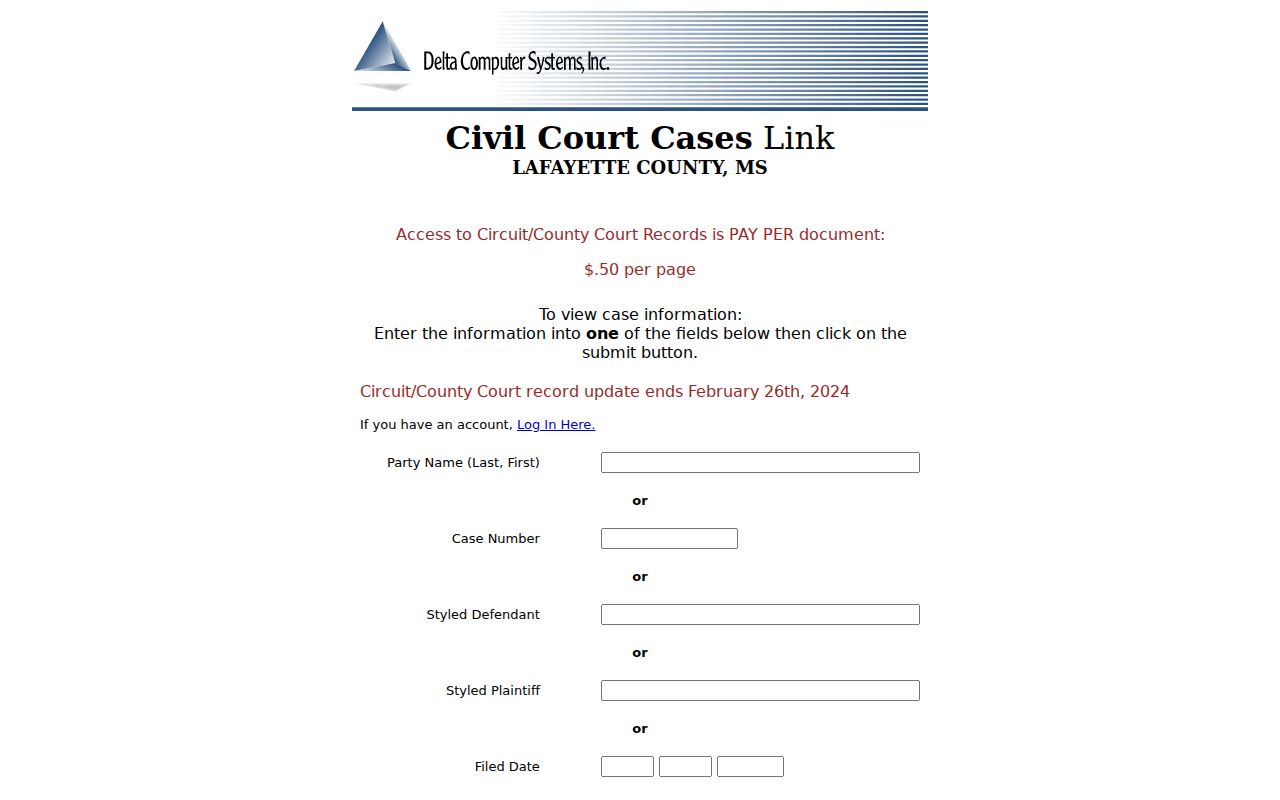
One habit pays off here. Check any name result against the court and date fields before treating it as a Lafayette County docket match.
| Search route | Best use | Important limit |
|---|---|---|
| Delta Circuit/County search | Local party, case, docket-book, and file-number lookup | Page says the record update ends February 26, 2024 |
| PAMEC/MEC | Participating electronic dockets, notices, and documents | Registration, charges, and restriction rules apply |
| Clerk-assisted search | Older, restricted, paper, or uncertain records | Give the court, names, year, and document needed |
What a Court Docket Shows
For Circuit and County Court, the Lafayette Circuit Clerk describes appearance, subpoena, execution, judgment, disposed-case, and final-outcome records. A docket is more than a calendar. Those entry types show why. One case history can run from a new filing to service, motions, an order of setting, a judgment, and post-judgment activity. Chancery, Justice, and municipal dockets follow the same case-history idea, though the exact fields and documents depend on the court and its access system.
Status flags need context. A "CLOSED" tag may be only administrative. The disposition or the signed order explains the real result. A "SEALED" or "Sealed_Case" flag marks an access limit. So does a permission message. Neither is an invitation to seek around it. When current status matters, the complete docket and the official court order control.
| Case number | The court’s identifier, often the most precise search key. |
|---|---|
| Parties and style | The named sides of the case, useful for checking a name search. |
| Filings and entries | Events such as an appearance, motion, subpoena, order, judgment, or disposition. |
| Setting | The date, time, court or division, and event type for a hearing or other court action. |
| Status and disposition | A current procedural label and, where entered, the result that resolved a matter. |
The Lafayette County Circuit Clerk explains the docket responsibilities behind these record categories.
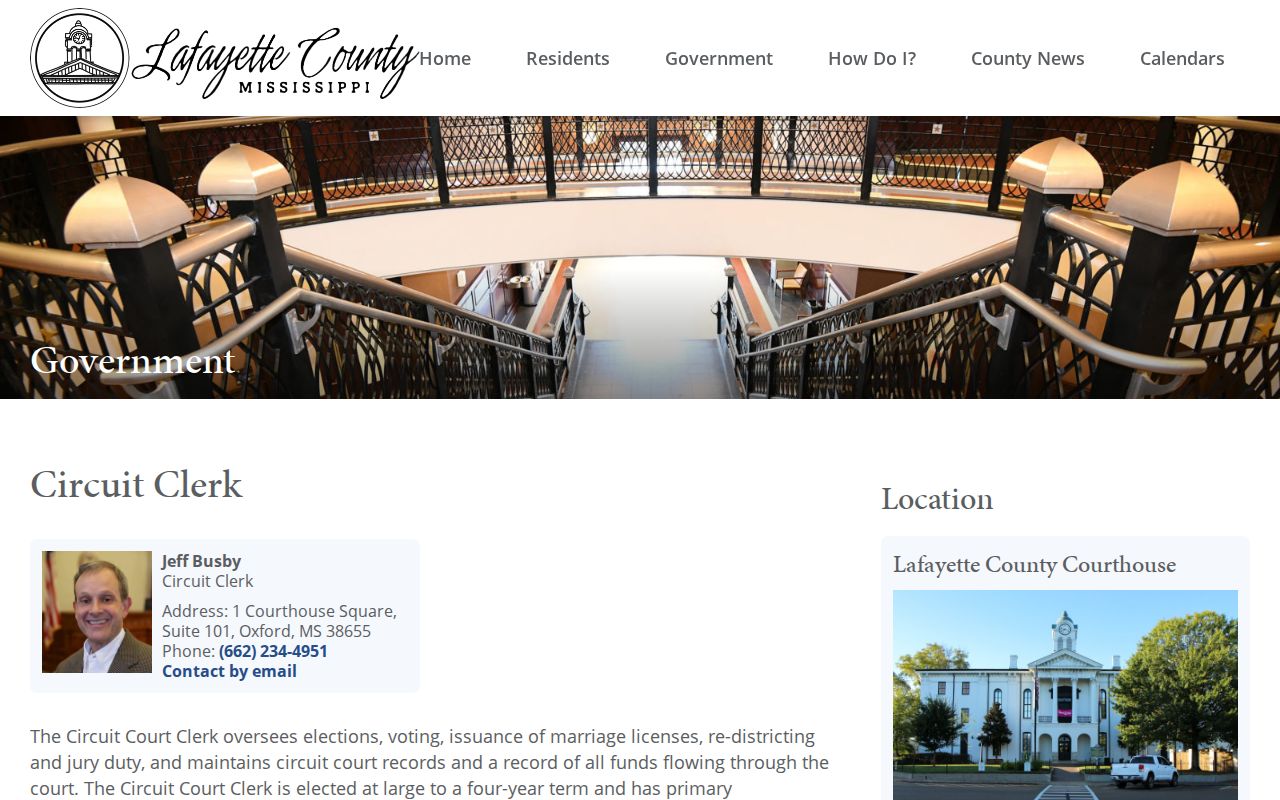
Each docket entry traces back to the Circuit Clerk.
Lafayette County MEC Records
PAMEC registration offers Attorney, Non-Attorney, and Firm Administrator accounts. A non-attorney account opens electronic documents, docket sheets, and notices in non-restricted cases for courts using MEC. The account is for the registrant's own use only. The published terms charge $0.20 per page returned by a search. Even a zero-match search costs that fee. The payment page also lists a $10 annual fee for attorney and non-attorney accounts, plus an online processing charge.
Lafayette Circuit and County Court joined MEC on February 26, 2024. Chancery got there first. Its county page says court documents went live in MEC on June 19, 2023, with attorney self-filing starting July 3. That gap explains the split in local records. Delta still serves a purpose. Its stated Circuit/County search fields and Chancery land records remain useful. But Delta is not current MEC court-document access. Third Circuit MEC Court Information identifies the Lafayette County transition and publishes the system's flag terminology.
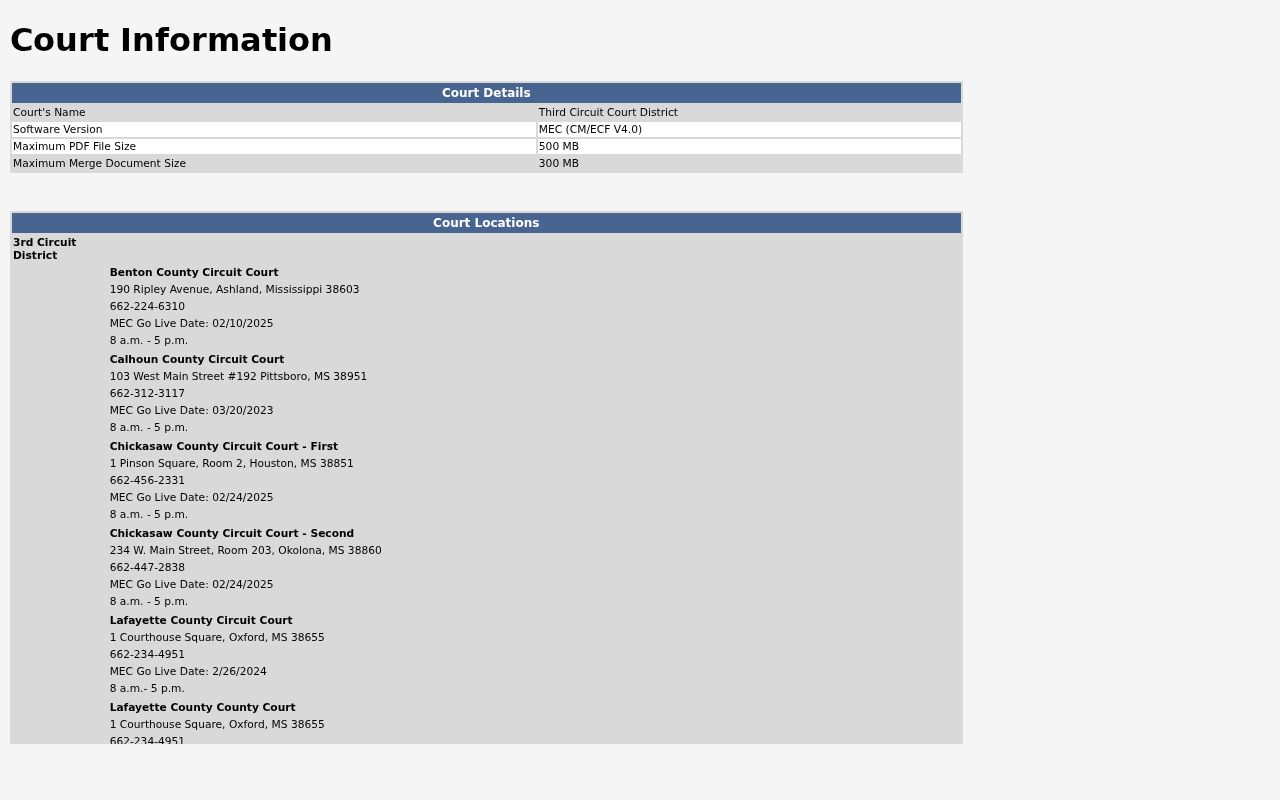
A real docket path is not a web search. The court-information display draws that line, and the PAMEC account screen documents the public registration route.
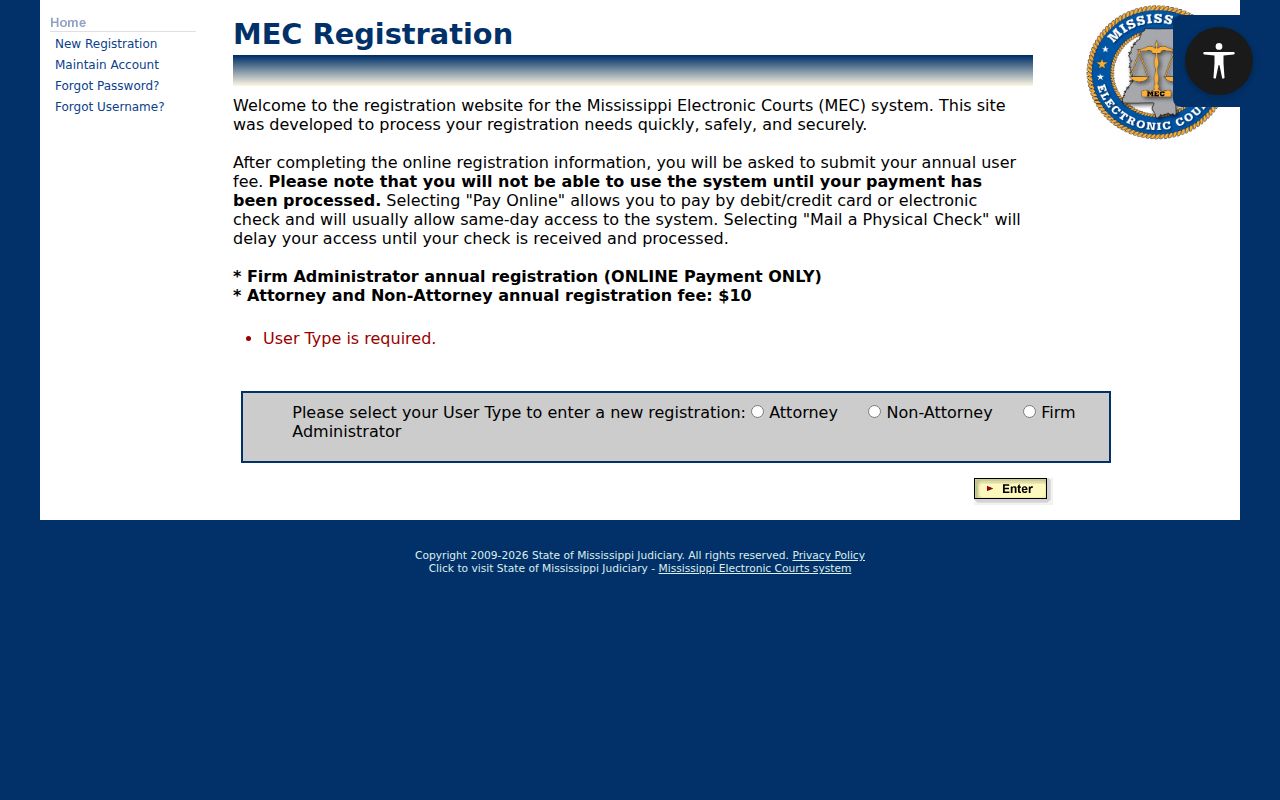
Registration comes with strings attached. Account rules and payment terms apply, so electronic access is never an unrestricted county index.
Which Courts Keep Dockets
Lafayette County's Courts page lists the Chancery, Circuit, County, Drug, and Justice Courts. Picking the right court is the first search decision. Circuit Court handles felony prosecutions, civil lawsuits, and appeals from lower courts. County Court arrived in 2023. It carries youth and eminent-domain jurisdiction. It also has concurrent civil jurisdiction up to $200,000, lower-court appeals, and limited criminal functions. Chancery takes a separate path. It covers equity, domestic relations, probate, and guardianship. It also handles related land matters through its own clerk and MEC route.
Justice Court is the usual county route for certain misdemeanors, preliminary felony matters, traffic outside municipal routing, and small civil cases. Municipal courts keep their own city dockets. Drug Court sits alongside these. One event can point to a different Lafayette County office. The issuing agency, court level, or type of appeal decides which. The county court listing provides the local starting point for these separate Lafayette County docket paths.
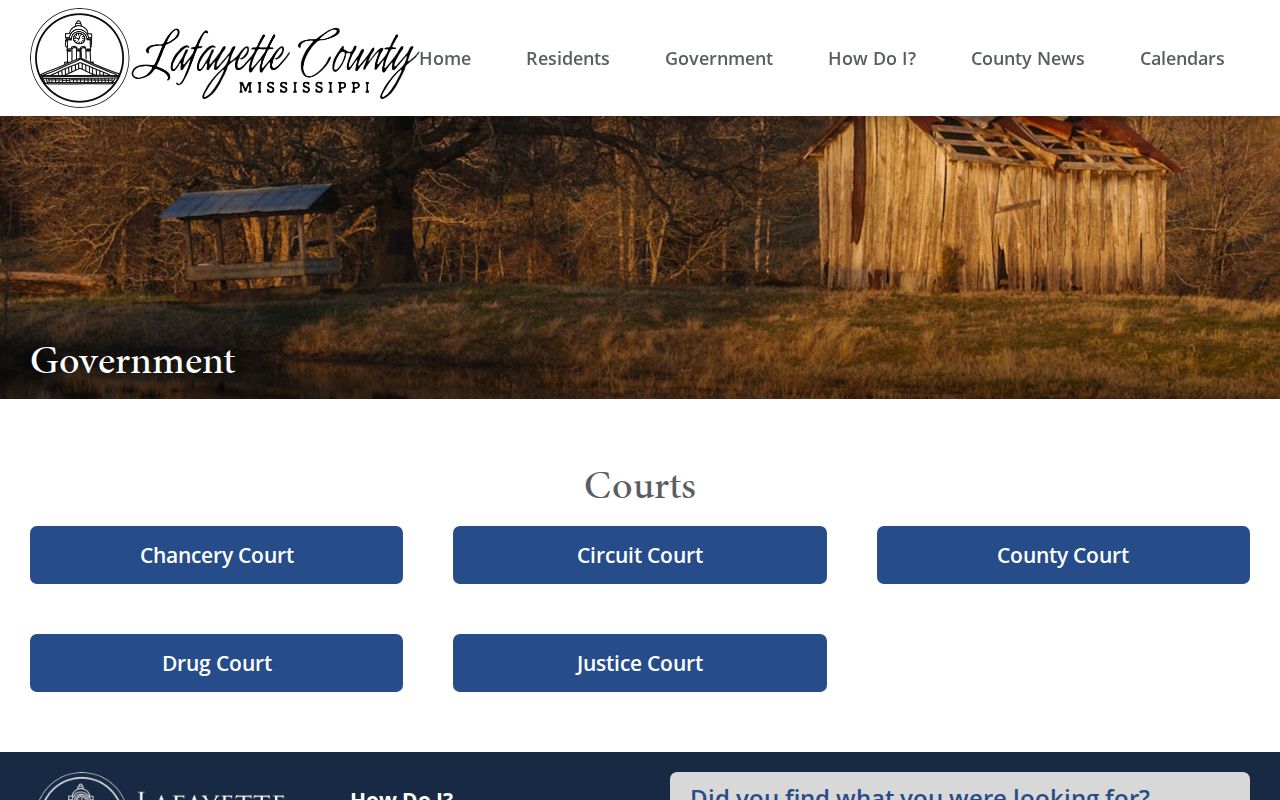
The official county overview shows each court office separately.
| Court | Docket covers | Where to start |
|---|---|---|
| Circuit Court | Felonies, major civil cases, lower-court appeals | Circuit Clerk, Delta, or MEC |
| County Court | Youth, eminent domain, qualifying civil cases, lower-court appeals | Circuit Clerk and MEC |
| Chancery Court | Equity, domestic relations, probate, guardianship, land disputes | Chancery Clerk and Chancery MEC |
| Justice Court | Specified traffic, misdemeanor, preliminary, and small-civil matters | Justice Court clerk |
| Municipal Court | City ordinances and city traffic matters | City court clerk or city portal |
The Mississippi Bar's court-structure overview supplies the statewide frame.
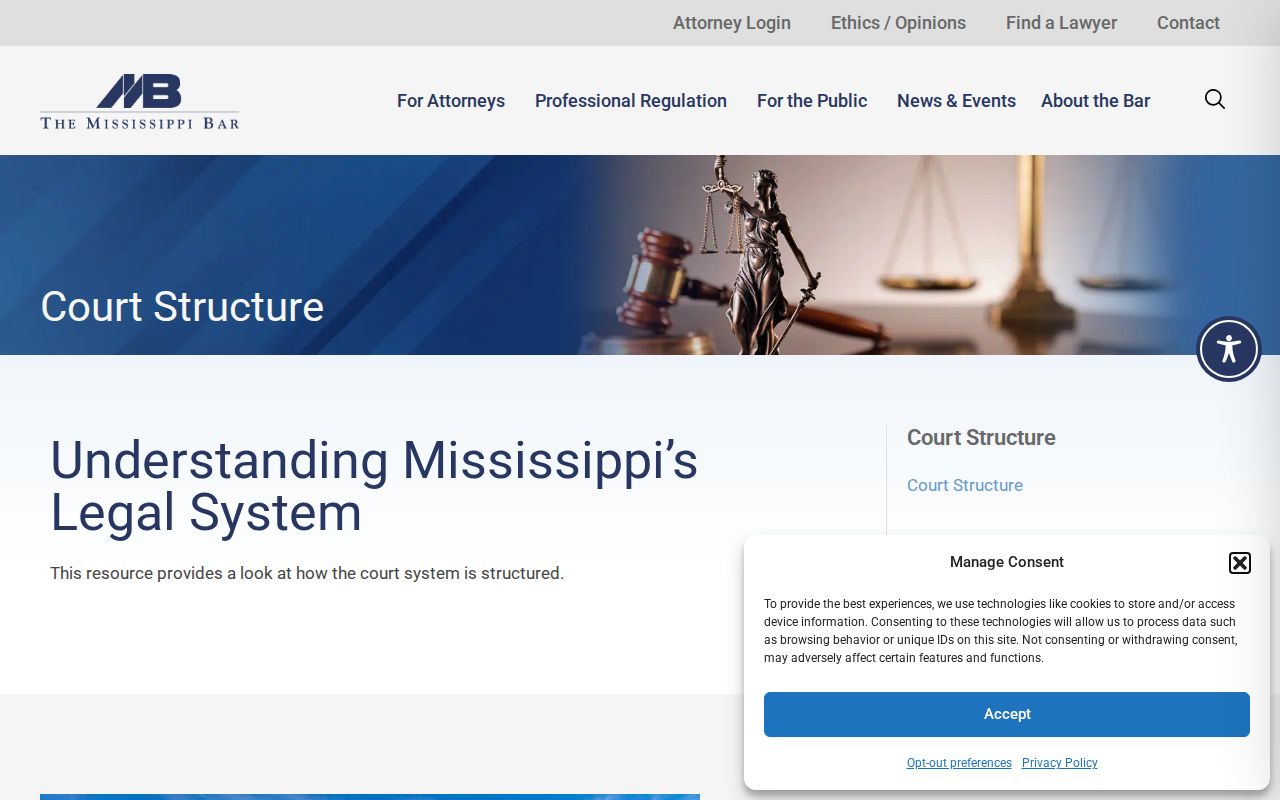
Keep a statewide structure reference handy whenever a Lafayette County docket shows an appeal, a transfer, or a court-level label you don't recognize.
Lafayette County Drug Court Docket
Lafayette County felony drug cases can land in a specialty program. It is the Third Circuit District Drug Intervention Court. It actually spans all seven counties of the Third Circuit. Entry is not automatic. Cases arrive through District Attorney referral and staff approval. Violent crime plus drug-related crime stays out. Participants commit to a rehabilitation program of at least three years. It includes random drug testing. The judge leads a weekly program docket call that anyone may attend. That docket call is program business, though, not a general criminal name search for Lafayette County.
Read a Drug Intervention Court entry as one piece of the referred case. It labels no one's overall Lafayette County criminal matter. Youth Court records carry their own confidentiality limits and are not ordinary public docket data. The county's Drug Court page is the official place to learn program details and participation boundaries.
Lafayette County Docket Terms
Flags on a MEC entry are shorthand. They never substitute for the event entry or the order behind it. "Arraignment Pending" means that stage has not happened yet. "BOUND OVER" signals a preliminary posture on its way to a higher criminal court. "Municipal Court Appeal" and "Justice Court Appeal" mark a lower-court matter climbing toward County or Circuit Court. Do not read any flag as a final result. Confirm the current court first. Then confirm the latest docket event on the case.
- Order of setting
- An order that places a hearing, trial, or other matter on the court calendar.
- Continuance or reset
- A court-approved move of a setting; the current notice or clerk confirmation controls.
- Disposition
- The recorded result resolving a matter, such as a dismissal, plea, judgment, or verdict.
- LegacyCase
- An MEC marker for an older-system case that may require extra care when locating records.
- Sealed or Sealed_Case
- An access-restriction marker; ask the clerk what lawful record, if any, is available.
Finding Court Dates and Settings
Read every Lafayette County setting in full. Check court or division, date, time, location, case number, case style, judge, event type, and any appearance instruction. A law day is not automatically a trial date. The local rules set Division I criminal law days on the first and third Monday. Civil law days follow on the Tuesday after. The rules also cap what may normally be noticed without the judge's permission. For your specific case, the current notice, the clerk, and the court calendar control.
Lafayette sits in the Third Circuit Judicial District, per the state's directory and calendar materials. County Court convenes in Courtroom 1. Chancery works through setting and reset orders. Justice Court sends you to the clerk, and each city keeps its own schedule. Lafayette County court calendar information walks through how to confirm dates court by court.
The Mississippi judicial directory and calendar page is the official statewide starting point for court-term material.
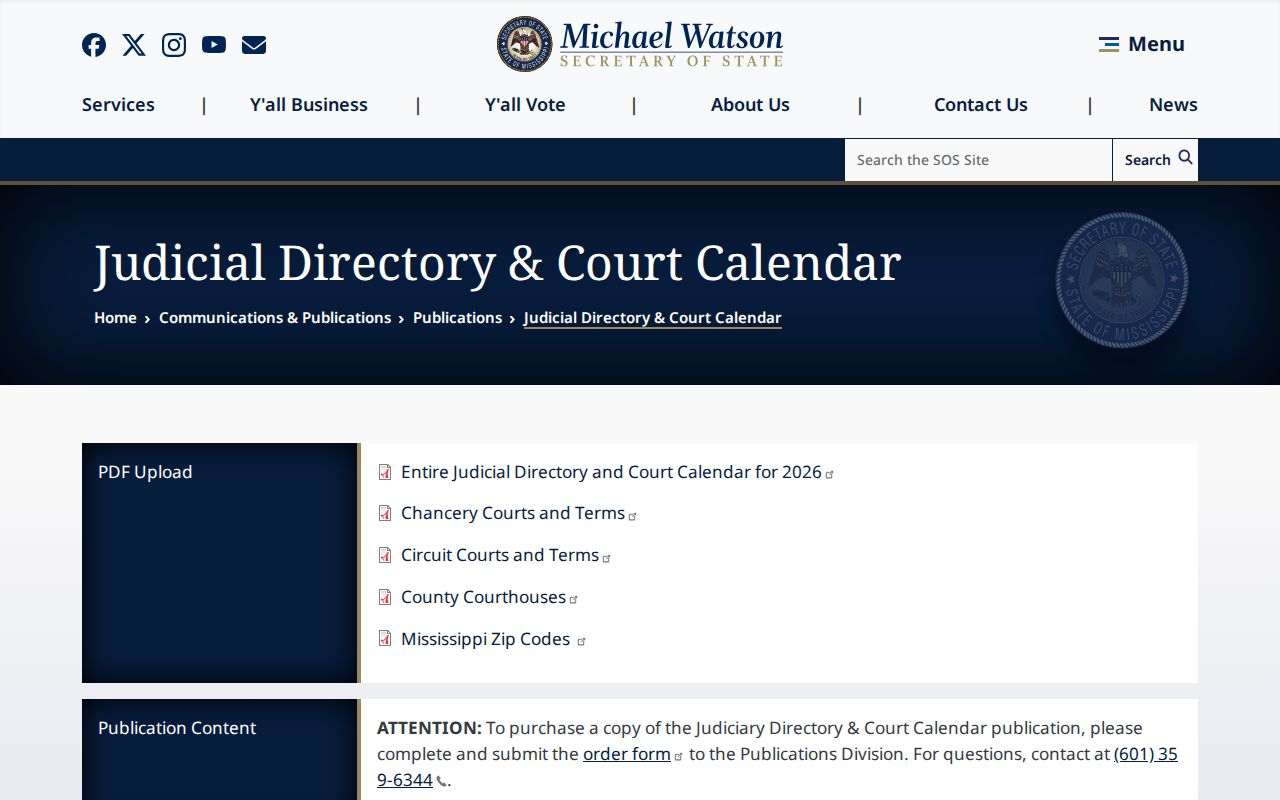
A court-term listing gives context only. The case docket and the clerk supply the current individual setting.
Lafayette County Court Locations
Three Lafayette County locations explain how the records split. The courthouse on the Oxford Square houses the Circuit Clerk's office. It also covers the County Court filing route. Chancery Court and the Chancery Clerk sit in the separate Chancery Building. Justice Court and Oxford Municipal Court operate from the Business Complex. Knowing the building narrows the likely docket custodian. It still does not replace checking the court division on the case or citation.
Circuit and County Court route
1 Courthouse Square, Oxford, MS 38655
Use the Circuit Clerk for Circuit and County Court records.
Chancery Court route
300 North Lamar Boulevard, Oxford, MS 38655
Use the Chancery Clerk for Chancery Court and land-record questions.
Justice and Oxford Municipal route
72 F.D. Buddy East Parkway, Oxford, MS 38655
Confirm the court and suite before appearing.
Lafayette County's official home page carries current county navigation for offices and public services.
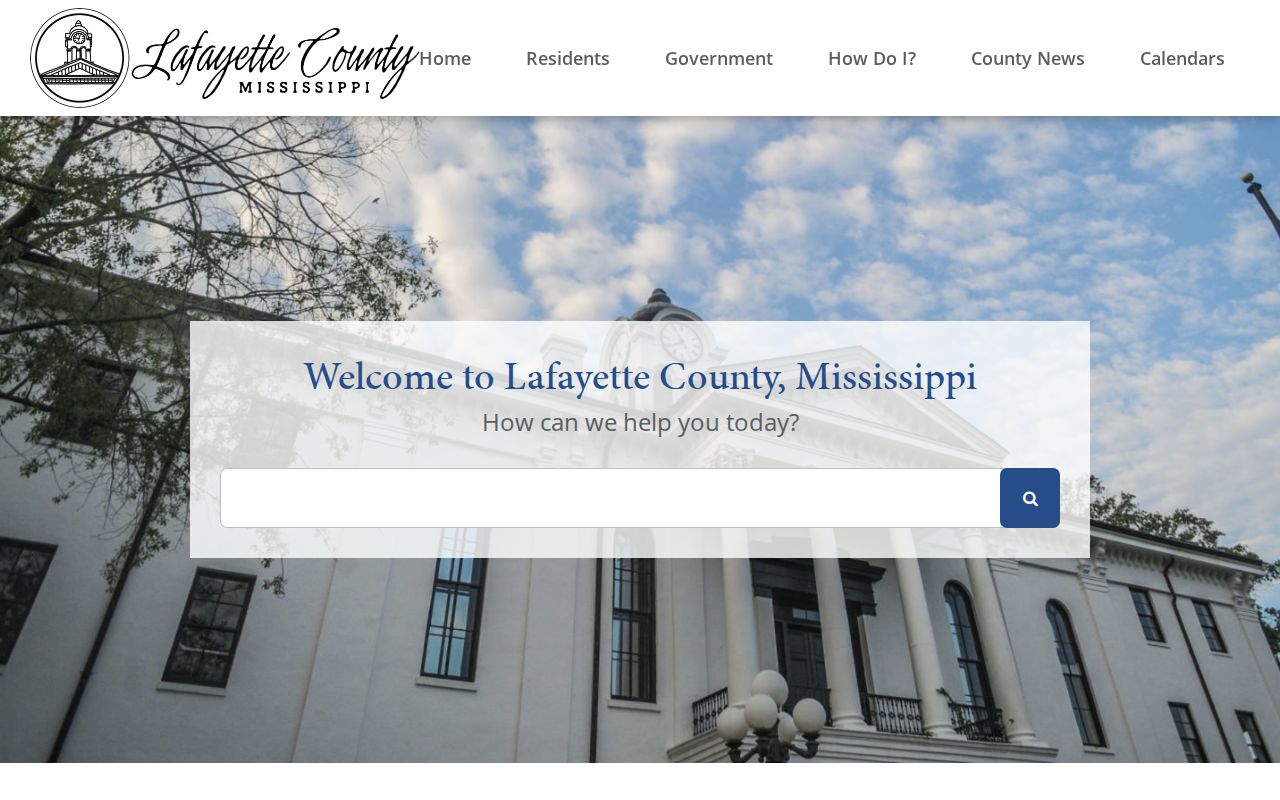
Check the named county office before any visit, payment, or record request.
Public Access to Dockets
Under the Mississippi Public Records Act of 1983, public records belong to the public. An exemption is the exception. The Act grants inspection and copy rights for non-exempt records. It also permits reasonable search, review, duplication, and mailing costs. When a record is partly exempt, segregable non-exempt material must be released. Court files still answer to court rules, sealing orders, youth protections, and MEC privacy requirements. So the Act does not put every docket detail or attached filing online. It is not all open to browsing.
A strong request names the court division, case number, party names, approximate date, and document title. State whether you need a plain or certified copy. Ask the clerk for a fee estimate before anything large. If a record is restricted, ask whether a docket sheet, judgment, order, or redacted version is lawfully available instead of treating a missing search result as proof no case exists.
Key rules:
Miss. Code §25-61-5 sets access and response timing rules for public bodies, subject to court-specific limits.
Miss. Code §25-61-7 permits reasonable actual costs for searching, reviewing, copying, and mailing.
Mississippi Rule of Civil Procedure 5.1 requires privacy protections in electronic court filing.
The Ethics Commission's Public Records Act explanation is the source behind these Lafayette County access principles.
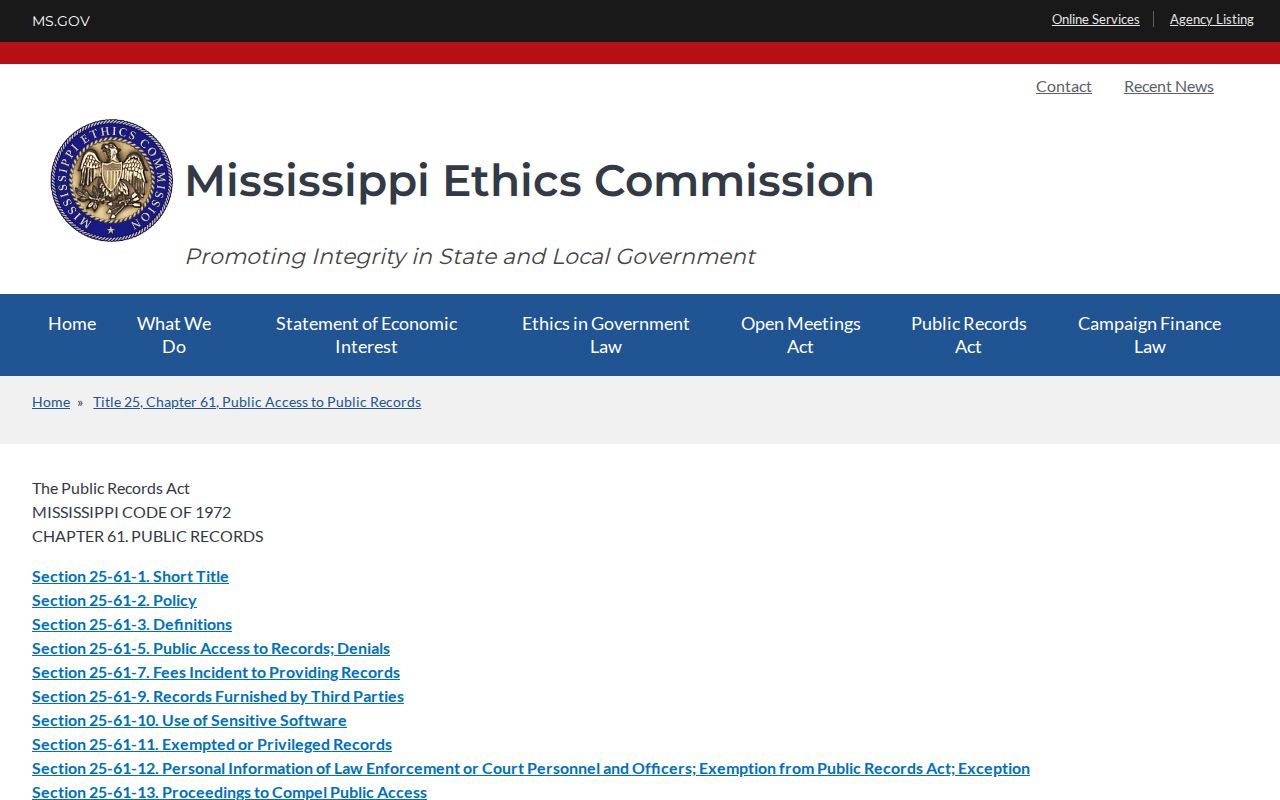
That official public-records page frames a docket request within state access rules while court confidentiality limits still hold.
Lafayette County Restricted Results
PAMEC access for non-attorneys reaches only non-restricted cases and documents. Chancery MEC may answer with a no-permission message. That happens when viewing is limited to counsel of record. Youth matters, sealed files, expunged matters, protected information, and sensitive Chancery subjects demand extra care. Never copy Social Security numbers, tax identifiers, dates of birth, minor names, financial-account numbers, or protected addresses. Take none of it from a docket or filing.
If you need a lawful record of an attempt, keep it to the court, a case number already lawfully displayed, the general case type, the date, and the restriction message. Ask the court or clerk. Ask whether a non-restricted docket entry or redacted copy exists. Never bypass a permission prompt. Do not try to rebuild restricted information from old search snippets.
Note: Registration opens an access route. It does not grant permission to see every Lafayette County case or document.
The Clerk and Docket Records
Every Lafayette County court docket starts with a division question. The Circuit Clerk keeps the docket for Circuit Court. It handles records duties for County Court as well, covering appearances, subpoenas, executions, judgments, disposed cases, and final outcomes. When you contact the clerk, give the division. Give the case number or a full party name, the rough filing year, and the exact document you want. It also helps to ask where the record lives: MEC, Delta, paper, microfilm, or archives. Ask too whether you need a plain copy or a certified one.
Chancery works differently. Its docket sits with the Chancery Clerk. That office also keeps the county's land records. Justice Court and each municipal clerk hold their own files. For more on telling a docket sheet apart from the actual filing behind it, see the Lafayette County court records page. It walks through copy requests step by step.
Lafayette County Circuit Clerk
1 Courthouse Square, Suite 101
Oxford, MS 38655
662-234-4951
Monday through Friday, 8 a.m. to 5 p.m.
Lafayette County Historic Records
Older Lafayette County records did not always begin as an electronic docket. Many still sit on paper or film. The Mississippi Department of Archives and History finding aid covers county records from 1830 through 1976. It includes Circuit Court Papers for 1860 through 1869. Those papers lack an index. Digging into that era may mean a finding aid, an archive box request, self-service microfilm, or a direct clerk inquiry. A modern name search may not be an option. The courthouse has stayed in use since the nineteenth century. That is why paper, archives, Delta, and MEC all coexist today. For population context beside the newer County Court structure, Census QuickFacts for Lafayette County shows the county's numbers on the official federal page.
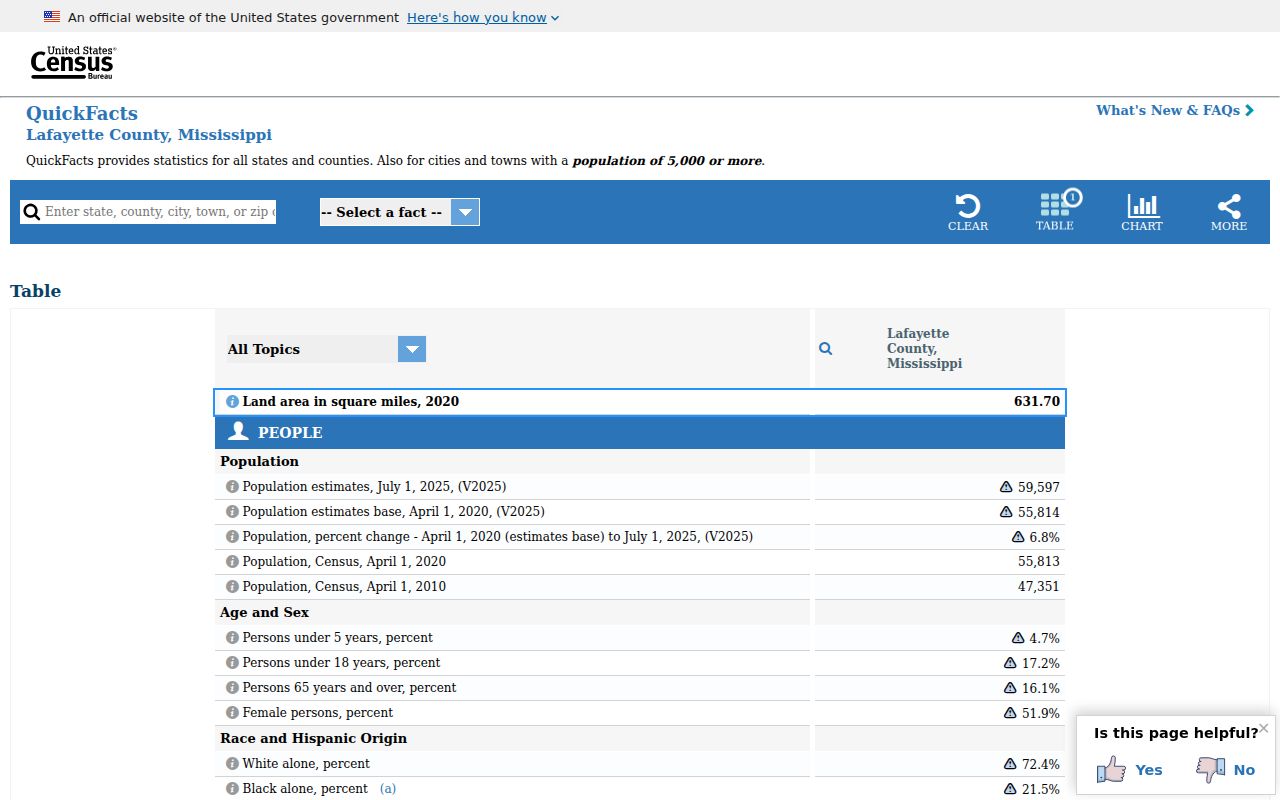
That population figure helps explain why Lafayette County added a County Court in 2023, giving its court docket system a second general-jurisdiction tier.
Court Dockets by City in Lafayette County
Per the 2020 Census incorporated-place table, Lafayette County contains exactly three incorporated places. They are Oxford, Abbeville, and Taylor. City cases and county court matters are not the same thing. Oxford runs the county's most visible municipal-court access route. Abbeville and Taylor depend on contacting the town court clerk directly. They have no public docket portal. If you hold a city citation, an ordinance matter, or a court date from a city, check first with the city court. That is the court that issued it. Anything else may belong to Justice, County, Circuit, or Chancery Court instead.
Oxford Court Docket
2020 Census population: 25,416. Municipal Court has an official linked active-case route and payment path.
Abbeville Court Docket
2020 Census population: 372. The Town/Court Clerk is the verified access route; no public portal was located.
Taylor Court Docket
2020 Census population: 355. Town ordinance matters are heard in the Town Hall Courtroom.
Map and Directions to the Lafayette County Courthouse
Circuit Court and County Court files are kept at the Lafayette County Courthouse at 1 Courthouse Square, in the middle of the historic Oxford Square. The Circuit Clerk's office is Suite 101. The 1871 Italianate building has been in continuous courthouse use since it was rebuilt after the Civil War and is a designated Mississippi Landmark. Chancery Court records are kept in a separate building, the Chancery Building at 300 North Lamar Boulevard, while Justice Court and Oxford Municipal Court sit at the Lafayette County Business Complex at 72 F.D. "Buddy" East Parkway.
Lafayette County Courthouse
1 Courthouse Square, Suite 101
Oxford, MS 38655
662-234-4951
Monday through Friday, 8 a.m. to 5 p.m.
The county's own courthouse page notes parking and transit information for the Square without listing specific spaces or routes, so a visitor should check that page or call the Circuit Clerk before arrival, especially since Chancery, Justice, and Municipal matters are handled at two other Oxford addresses rather than the courthouse itself.